
Introduction
CFD simulations remain a cornerstone of everyday automotive engineering; however, the demand for shorter turnaround times and higher productivity continues to grow. Although today’s widely discussed AI-driven surrogate models promise near-instant drag predictions, CFD also holds a strong position in quick-turnaround simulations. Today, thanks to highly optimized numerical algorithms and continuous advances in hardware performance, modern CFD running on state-of-the-art CPUs can deliver accurate drag predictions within minutes. In contrast to AI-based approaches, near real-time performance can be achieved without the time and cost associated with training AI-driven models. This makes CFD a compelling alternative to AI-based surrogate interpolations.
At ICON, we have been pushing the limits of CFD for decades – combining deep scientific know-how with practical engineering experience – to deliver to industry accurate, robust and remarkably fast CFD methods. The latest version of ICON CFD software product, iconCFD v5, introduces a unique technology stack that once again pushes the boundaries of industrial automotive CFD in speed, accuracy, and robustness. Its key components include:
- iconSeamlessSolve – a brand new pressure-based unified solver for steady and transient flows
- Major revision of pressure stabilization method
- Higher order pU-coupling operators
- Enhanced SIMPLEST preconditioner
- Non-orthogonal limiters-free pressure equation solver
- Enhanced corrector step (solving for exact continuity equation)
- PBMAS – Performance Based Memory Aligned Streamlining
- Mixed precision approach in iconCFD
- Precision-sensitive algorithms/methods evaluated at double precision and stored at single precision
- iconPlatform – a CAE simulation environment designed for an AI-enhanced future
- All simulation data is managed on the single web-browser interface
- Software agnostic graphical interface to all data / all simulations / all HPC
- Well organized data for easy postprocessing, comparison and AI training
Automotive Benchmark
The above-described new technologies are demonstrated using the well-known DrivAer car model from TUM, a representative and widely used benchmark in automotive aerodynamics. The cooling package, including the condenser and radiator, is modeled using porous media method. Rotating wheels are represented via simple moving wall boundary conditions, combined with a five-belt ground system consistent with experimental wind tunnel setup.
To demonstrate sensitivity to geometric changes, three body shapes are evaluated: Sedan, Fastback, and Pickup. While the difference between the Sedan and Fastback body shape is minor in terms of geometry and aerodynamic drag, the Pickup body shape represents a substantially larger deviation, transitioning from streamlined forms to a bluff body geometry with massive wake region and a significant impact on aerodynamic drag.
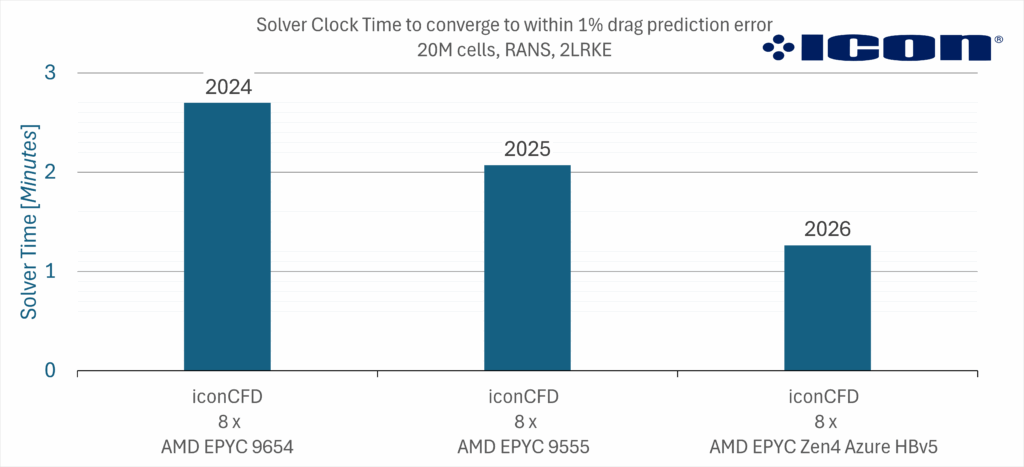
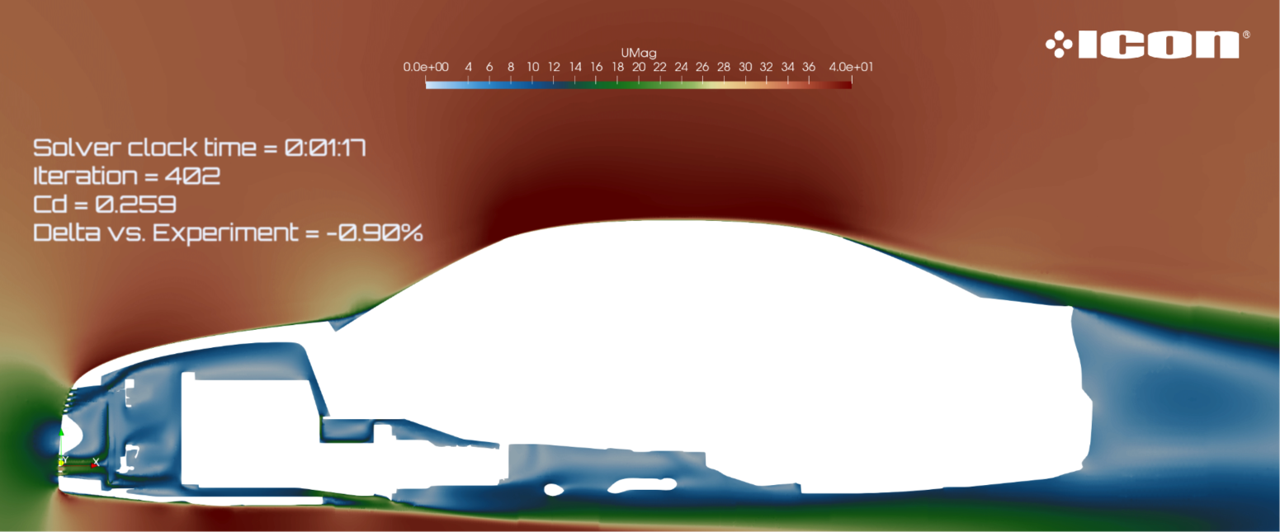
Figure 1: Evolution of steady-state iconCFD wall-clock time for the DrivAer Sedan across successive AMD EPYC CPU generations over recent years. Simulation turnaround time has decreased significantly through the combined evolution of computing hardware and iconCFD. The latest HBv5 systems provide an additional performance boost through their high-memory-bandwidth architecture, enabling iconCFD to reach within 1% drag prediction error in approximately 400 iterations and just one minute of wall-clock time.
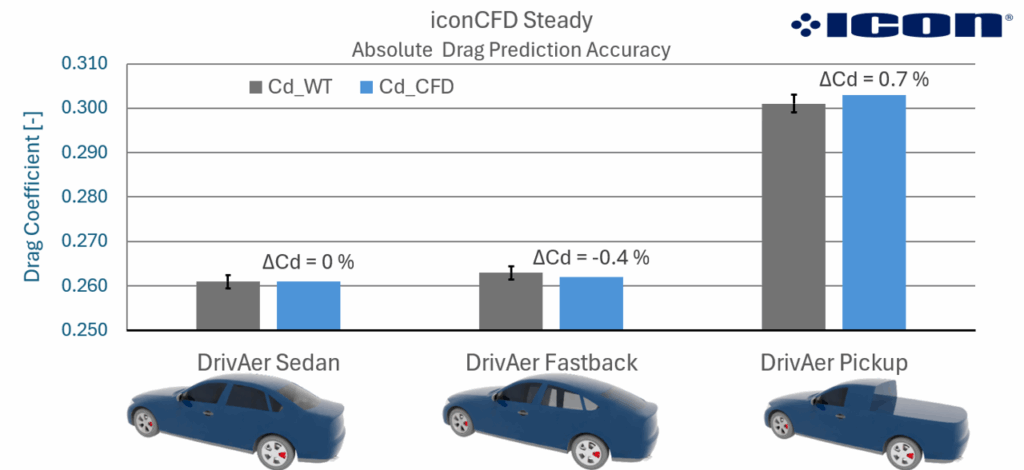
Figure 2: Absolute drag prediction accuracy of steady iconCFD simulations (blue) for the DrivAer Sedan, Fastback, and Pickup, compared with full-scale wind tunnel data (grey). The iconCFD drag prediction error is below 1% for all three configurations.
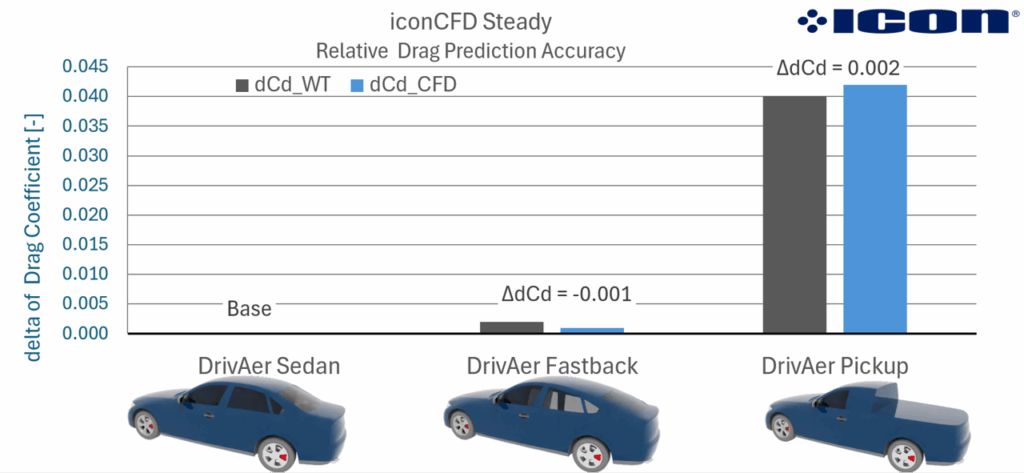
Figure 3: Relative drag prediction accuracy using the DrivAer Sedan as the baseline variant. Experimental (grey) and iconCFD (blue) results show strong agreement in predicting drag changes: +0.002 vs. +0.001 for the Fastback and +0.040 vs. +0.042 for the Pickup, accurately capturing both subtle and major geometry effects.
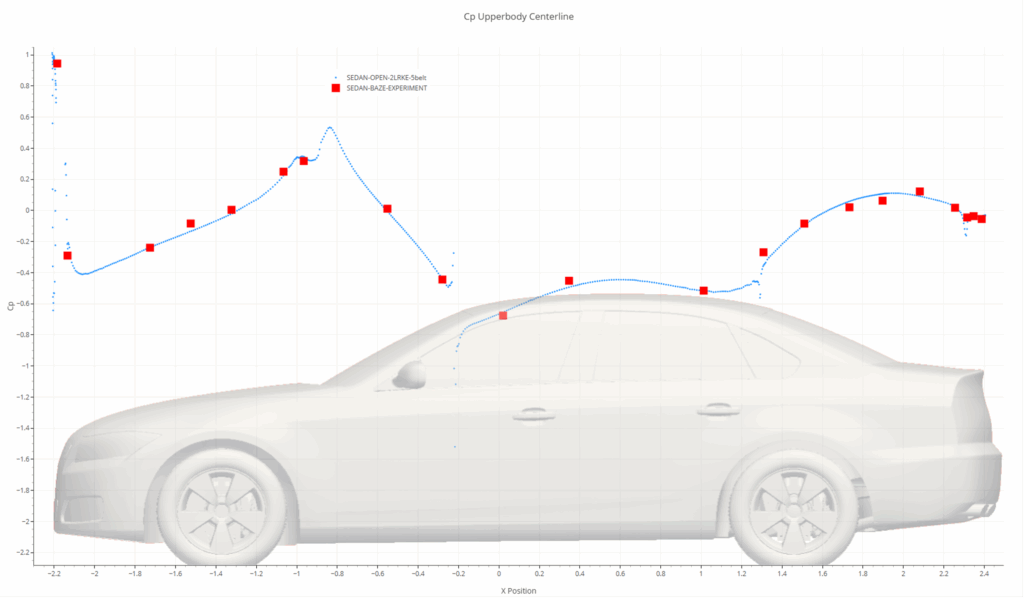
Figure 4: Pressure coefficient (Cp) distribution along the DrivAer Sedan upper-body centerline, showing excellent agreement between iconCFD predictions (blue) and full-scale wind tunnel measurements (red).
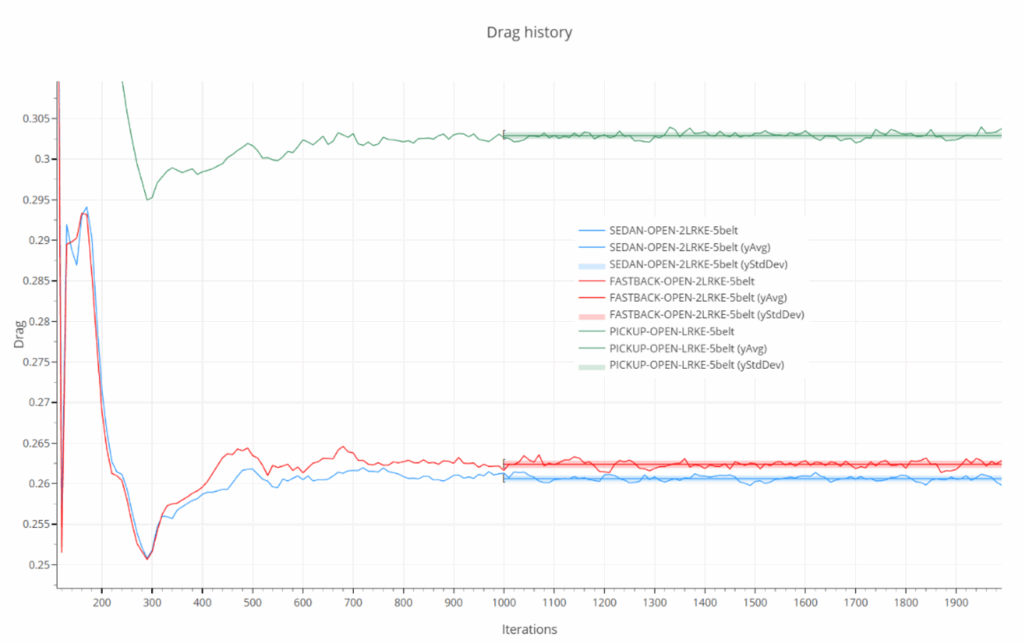
Figure 5: Drag convergence histories and automatic averaging operation in iconPlatform for the DrivAer Sedan (blue), Fastback (red), and Pickup (green) configurations, showing fast convergence and drag force stabilization.

Figure 6: Comparative view of the DrivAer Sedan, Fastback, and Pickup, colored by surface friction coefficient, as visualized in iconPlatform, enabling easy and interactive exploration of flow quantities.
