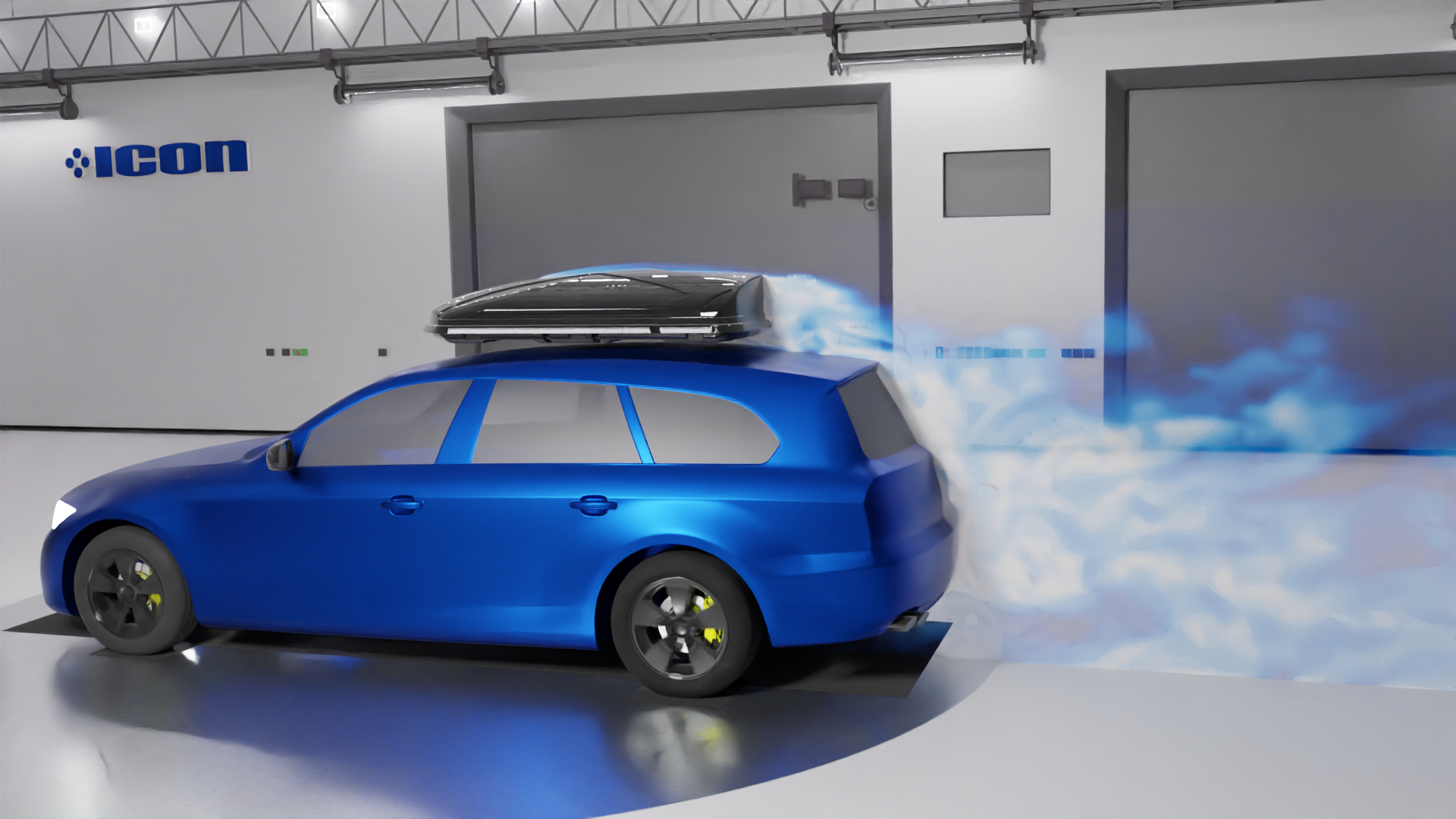
When it comes to roof boxes, most discussions focus on aerodynamic drag. However, a roof box does much more than simply add frontal area and increase drag. By altering the airflow around the vehicle, it creates entirely new flow structures that significantly affect the pressure distribution and, in turn, influence another important but often overlooked characteristic: vehicle lift and high-speed stability. What makes this particularly interesting is that the impact on stability can differ substantially between saloons and estates.
Why the aerodynamic effects of a roof box can be particularly important for estate cars and potentially more so than for saloons?
The wake generated by the roof box can partially shield the rear window from the high-speed flow that normally creates an area of relatively low pressure. Furthermore, the interaction between the roof-box wake and the rear-window boundary layer exposed to adverse pressure gradient may trigger premature flow separation. The effect is a reduction in rear-axle lift. While aerodynamic drag increases substantially, the lower rear lift improve straight-line stability which may improve the vehicle’s behavior at higher speeds.
Figure 1: Flow visualization of the wake behind a generic saloon car without and with a roof box. In the baseline configuration (upper image), the flow over the rear window remains mostly attached, exhibiting only minimal separation. In contrast, the wake generated by the roof box promotes large-scale flow separation from the rear window, resulting in a substantially different wake topology.
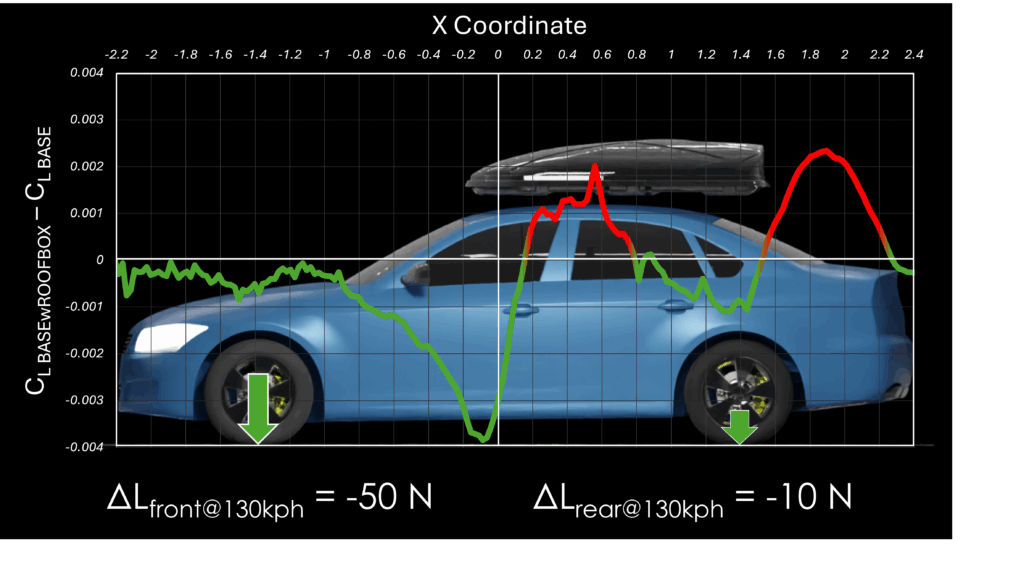
Figure 2: Effect of roof-box installation on the longitudinal distribution of lift of a saloon vehicle, represented using a bin chart. The presence of the roof box results in reduced lift across the forward section of the vehicle (green curve segment). In contrast, the rear section exhibits a mixture of regions with both increased and decreased lift. Of particular interest is the roof-to-rear-window transition region, where the roof box lowers the local lift contribution (green segment). When integrated over the vehicle body, these changes correspond to a reduction in front-axle lift and a neutral to slightly reduced rear axle lift. At 130 kph, the aerodynamic lift effect of the roof box is a small reduction in overall vehicle lift force, corresponding to a force equivalent to only a few kilograms – approximately 5kg on front and 1kg on rear axle. Consequently, the impact on vehicle stability is expected to be minimal and unlikely to be perceptible to the driver.
For estate vehicles, however, the story is often quite different. Many estates generate significantly lower rear lift than their saloon counterparts. In some cases, the rear axle may even experience a small amount of aerodynamic downforce. This behavior is often attributed to a strong upwash of the underbody flow, which lowers the pressure in the diffuser region and contributes to lower rear-axle lift. As a result, estates can exhibit better straight-line stability despite their larger rear volume.
The installation of a roof box can compromise this beneficial aerodynamic characteristic. By modifying the flow structures in the vehicle wake, the roof box may weaken the mechanisms that help keep rear lift low. Consequently, rear-axle lift can increase significantly, leading to reduced high-speed stability and a more nervous vehicle response at high speeds compared with the same vehicle in its standard configuration.
Figure 3: Flow visualization of the wake behind a generic estate car without and with a roof box. In the baseline configuration (upper image), the significant upwash of the underbody flow accelerates the airflow and reduces pressure in the diffuser region, producing a small amount of downforce on the rear axle. In contrast, the interaction with the roof box significantly changes the wake structure, with an evident reduction of the underbody-flow upwash.
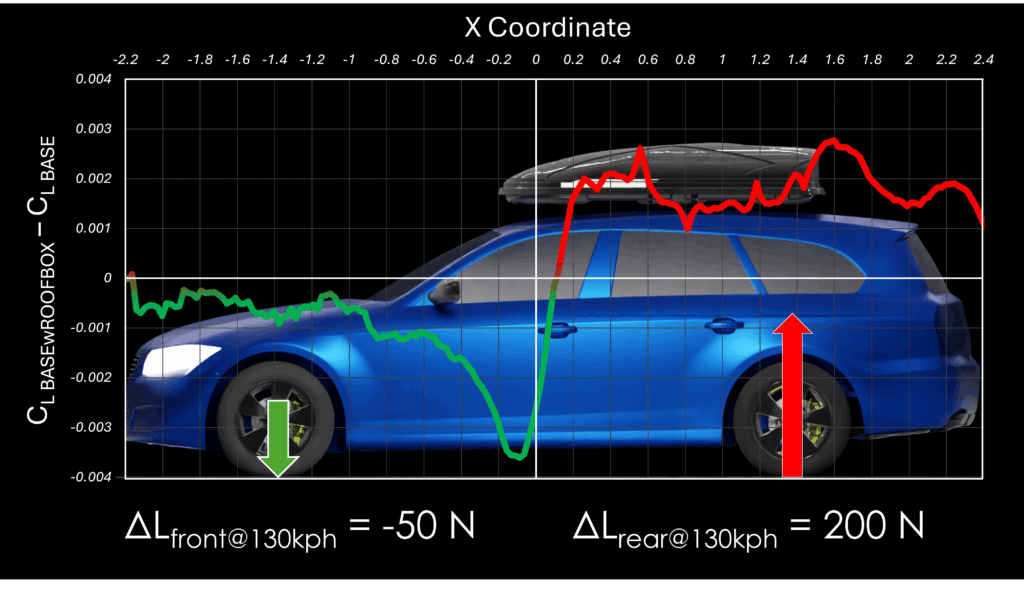
Figure 4: Effect of roof-box installation on the longitudinal distribution of lift of an estate vehicle, represented using a bin chart. The presence of the roof box, similarly to saloons, results in reduced lift across the forward section of the vehicle (green curve segment). In contrast, the rear section exhibits a significant increase in lift (red curve segment). When integrated over the vehicle body, these changes correspond to a reduction in front-axle lift and a substantial increase in rear-axle lift. At 130 kph, the resulting aerodynamic force can lift the rear axle by the equivalent of approximately 20 kg, which may have a noticeable effect on vehicle stability, particularly when driving a lightly loaded estate car with a roof box installed.
Vehicle aerodynamics cannot be reduced to a single drag coefficient. Accurate predictions of complex flow physics is essential for safe and competitive product design.
At ICON, we have developed our unique Digital Wind Tunnel: a cost-effective alternative to traditional wind tunnel testing. It enables automotive OEMs, accessory manufacturers, motorsport teams, and engineering consultancies to evaluate, develop, and optimize aerodynamic designs in minutes rather than days.
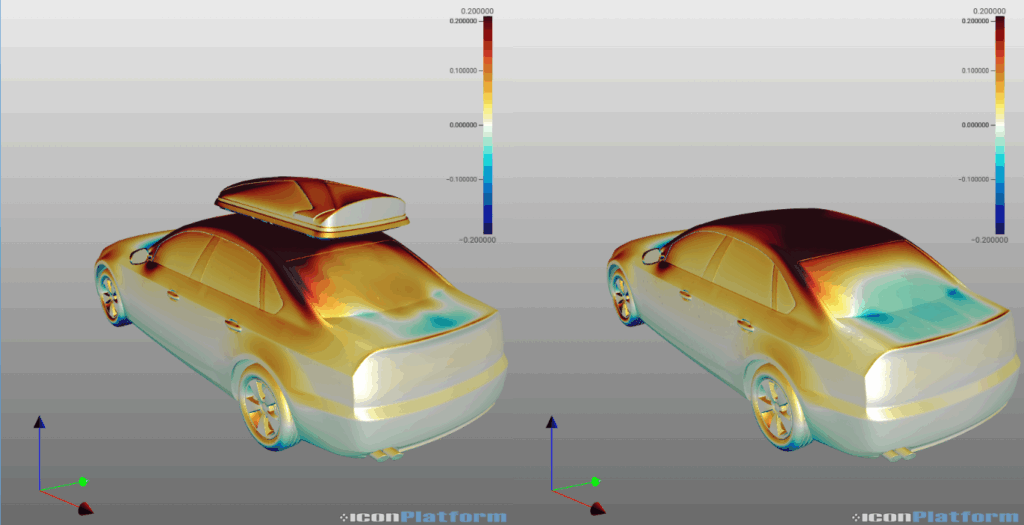
Figure 5: Interactive comparative 3D view of the saloon baseline and roof-box configurations, colored by lift force, as visualized in iconPlatform, enabling easy exploration of aerodynamic loads and many other flow quantities.

© ICON 2025. All rights reserved. | Legal | Website by FocusedCRE
